

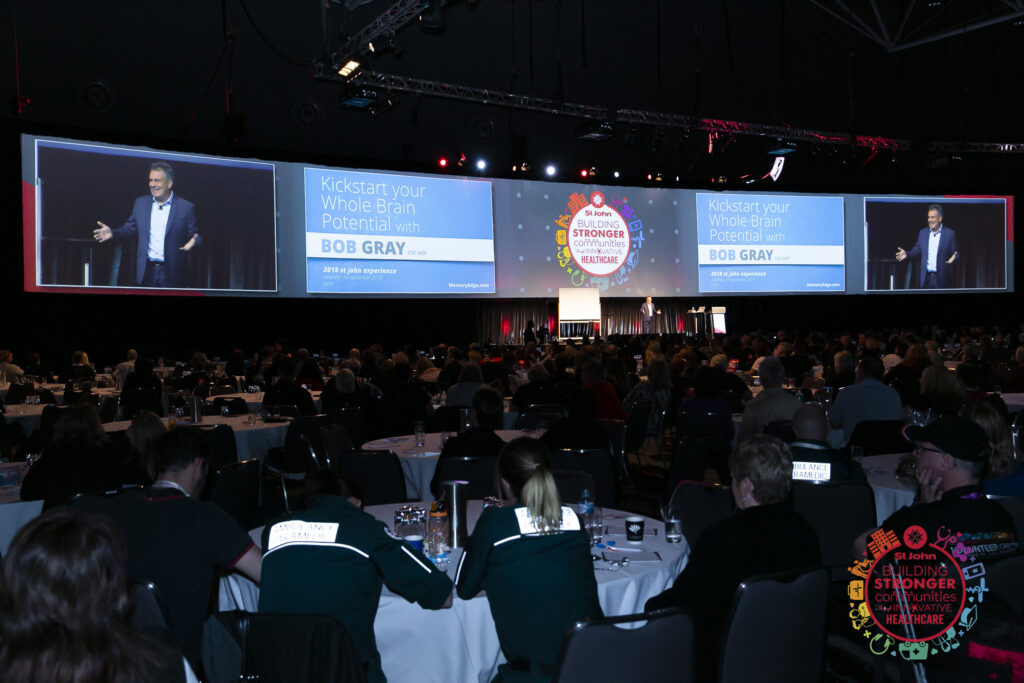
Here’s a scenario every keynote speaker for meeting planners should probably hear.
You’ve booked the venue. The agenda is set. You’ve got your keynote speakers lined up, good speaker reels, solid reviews, a message about resilience or leadership or embracing change. Perfectly fine. Perfectly… fine.
And somewhere in the back of your mind you’re quietly hoping this one lands well.
I get it. I’ve been on the other side of that equation for almost 40 years.
Here’s the thing I keep coming back to after all that time on stage: audiences don’t walk away remembering inspiration. They walk away remembering experiences. The moment the room erupted in laughter when they weren’t expecting it. The moment something clicked that they genuinely didn’t see coming. And this is the part that still gets me, the moment later that same evening when they tried something they just learned and it actually worked.
That’s what I do. It just doesn’t fit in any category you’d expect.
It’s Not a Memory Show. It’s Something Harder to Explain Than That.
In nearly four decades of professional speaking, I can count on one hand the number of times someone has called me specifically looking for a “memory speaker.” It almost never happens that way.
What does happen, usually after someone has seen a clip, or gotten a referral from another planner, is a conversation that starts with, “So what exactly do you do?” Because what I teach doesn’t fit neatly into the usual keynote slots. It’s not motivation. It’s not a leadership framework. There’s no audience ‘repeat after me’ chants or ‘raise your hand if…’ No motivational acronyms or Winston Churchill or Ghandi quotes, which frankly puts me in a pretty small club.
What it is, at its core, is this… remembering people. Their names, the things they’ve told you, the personal details that matter to them.
Simple to say. Genuinely rare to do.
In most rooms I walk into, the majority of people in the audience will forget the name of someone they just met within about 30 seconds of the introduction. Not because they’re distracted or rude, they just weren’t taught any other way. And nobody has ever stood up at a conference and said, “this is actually costing you business.” Until now, I suppose.
The professional who actually remembers, who runs into a client three months later and uses their name, who asks about the thing they mentioned last time, who remembers the name of their partner, or children because they were genuinely paying attention, that person builds relationships that don’t require a follow-up email to keep warm. It’s a trust skill, a relationship skill, and once you see what it does for referrals and retention, you realise it’s a revenue skill too.
Oh, and when I teach it, people laugh, a lot, that part matters more than most speakers will admit.
What Meeting Planners Actually Tell Me Afterward
The feedback I get most often has nothing to do with memory techniques specifically. It’s about what happened in the room.
“The audience was so engaged.”
“They were still talking about it at dinner.”
“You made me look good.”
That last one is my favourite. Mostly because I appreciate the stress and uncertainty every meeting planner experiences.
Here’s why I think it works. The topic is a genuine surprise. Nobody sits down expecting to pick up a skill that’s going to change how they operate both professionally and socially before they get home. They think they’re attending a keynote. What they get is something closer to a show, with real takeaways woven in so naturally that by the time they notice how much they’ve learned, they’re already using it at the conference.
I’ve worked with as diverse an array of clients as financial advisors to dental professionals who feel embarrassed when bumping into their clients/patients locally and forgetting their names. Sales teams have told me that something as straightforward as actually remembering a client’s name and using it naturally, because they genuinely remembered it, have shifted entire tones of conversations. I’ve had association members come up to me years later and quote back things they memorised at one of my keynotes.
I’m not saying this to impress you. I’m telling you because meeting planners deserve to know what they’re actually booking, not just what looks good on a one-sheet.
Who It Works For
Honestly? Almost any room.
That’s not me avoiding the question, it’s genuinely one of the more useful things about this topic. Whether your audience is made up of financial professionals, insurance advisors, healthcare workers, salespeople, executives, or association members, they all operate in the same environment: if their product or service is good, then their success is built on relationships, and relationships start with making people feel like they matter, like they are valued.
I’ve delivered this keynote in more than 35 countries, across financial services, real estate, dental and medical associations, corporate sales teams, and a few industries I probably couldn’t have predicted when I started out. The reason it translates isn’t because I adjust the material for each group, it’s because the human need is the same everywhere. People want to feel seen. The professionals who can make them feel that way have an edge that’s very hard to replicate any other way.
The Part I Didn’t Expect to Become So Relevant
There’s a section I include in almost every talk now that wasn’t part of my original program. It found its way in gradually, because I kept noticing the reaction it got.
It’s about technology. Specifically, about what we’ve quietly handed over to our devices without really deciding to.
We don’t memorise phone numbers anymore. We don’t remember directions. We don’t retain the details of conversations because we assume we can look everything up later, find the person on LinkedIn, check the notes app, re-read emails, and to be fair, mostly we can.
Except the moment of connection doesn’t wait for later. That introduction at the welcome reception, that conversation over lunch, that two-minute exchange before the session starts, those moments either build something or they don’t. No app goes back and rescues a first impression. No CRM makes someone feel like you actually remember them.
It’s a point that lands differently depending on the audience, but it always lands. And it opens up a conversation that goes well beyond remembering names. It’s about attention, about presence, about what it actually means to show up for the people in front of you.
If You’re Looking for Something Different
I know meeting planners are not short on options. Speaker bureaus, LinkedIn, your own network, there’s no shortage of people who will tell you they’re unique and engaging and guaranteed to get your audience fired up.
What I’d say instead is this, if your audience has sat through enough sessions about unlocking potential and leaning into disruption, and the new darling AI, and you want to give them something they’ll actually use, a skill they’ll try before the conference is even over, delivered in a way that makes the room genuinely engaged, I think we should talk.
Nearly 40 years, I still love my job. The material is tight, the laughs are real, and people notice the results fast enough that they come back and tell you about it.
That’s the best pitch I’ve got. I think it’s a pretty good one.
Bob Gray is a keynote speaker who has spent nearly four decades helping professionals in financial services, sales, healthcare, and associations build stronger relationships through the lost art of actually remembering people. He has spoken in more than 35 countries across 6 continents and is based in Canada. Learn more at memoryedge.com.